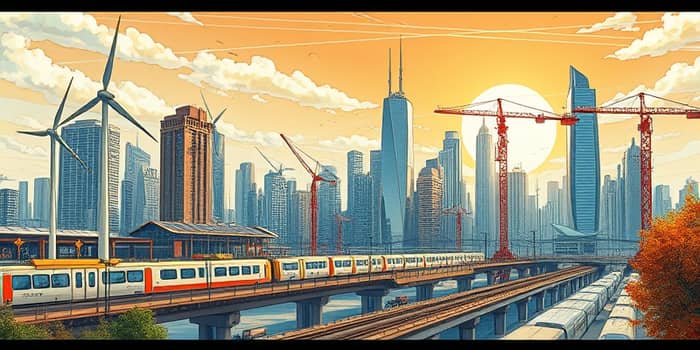
In an era defined by rapid change and evolving needs, infrastructure remains the backbone of economic growth and social progress. As we look toward 2025 and beyond, the scale and scope of global infrastructure investment reach unprecedented heights, offering both opportunities and challenges.
Infrastructure is more than concrete and steel—it is the foundation for sustainable economic growth and societal well-being. From roads that connect remote communities to data centers that power the digital age, each project shapes our collective future.
Investments in transport, energy, water, and social facilities not only drive GDP expansion but also foster job creation, poverty reduction, and enhanced quality of life. Recognizing its pivotal role, governments and private stakeholders worldwide are mobilizing record capital to build, modernize, and future-proof critical assets.
By 2025, total global infrastructure investment is projected at $3.4–$3.8 trillion annually. This historic influx reflects a universal acknowledgment that robust infrastructure underpins resilience and prosperity in a complex world.
Key regional commitments include:
Annual public infrastructure spending now approaches 2.6% of global GDP, rising to 3.6% in emerging markets. These figures underscore a global consensus: infrastructure investment is essential for navigating demographic shifts, urbanization, and climate imperatives.
The diversification of investment highlights how different sectors compete for funding in a crowded market. The following table illustrates key values and trends for leading infrastructure categories:
Despite unprecedented investment, a $15 trillion shortfall looms by 2040, driven by underinvestment in roads, grids, water systems, and digital connectivity. Meeting the annual requirement of 3.5% of global GDP (about $4.2 trillion) is critical to avoid bottlenecks in growth and resilience.
Emerging markets face the steepest deficits: two-thirds of future needs lie outside mature economies. Funding constraints, regulatory delays, and political risks further hinder project delivery. Climate-related shocks underscore the urgency of resilient design, including floodproofing, heat-resistant materials, and smart urban planning.
To bridge the gap, stakeholders are embracing technological advancements in construction such as AI-driven planning, robotics for accelerated building, and advanced analytics for predictive maintenance. Greenfield investments grow by 15% YoY as M&A deals slow, signaling a renewed focus on new capacity.
Creative PPP structures offer risk-sharing and yield enhancement, attracting private capital to traditionally underfunded sectors. Regional diversification also rises, with Latin America and Africa emerging as strategic destinations under friendshoring initiatives and trade diversification plans.
Looking ahead, global infrastructure needs swell to $106 trillion by 2040. Institutional investors are expected to increase their share, particularly in renewables, digital, and resilient infrastructure. With 86% of investors anticipating deal growth by 2025, optimism prevails in the U.S. and Europe, while emerging markets prepare for moderate rebounds.
Achieving a sustainable and resilient infrastructure future will require raising annual spending closer to 5% of global GDP. By aligning public policy, private capital, and innovative technologies, stakeholders can build the robust systems needed to support the next generation of economic progress and social well-being.
References