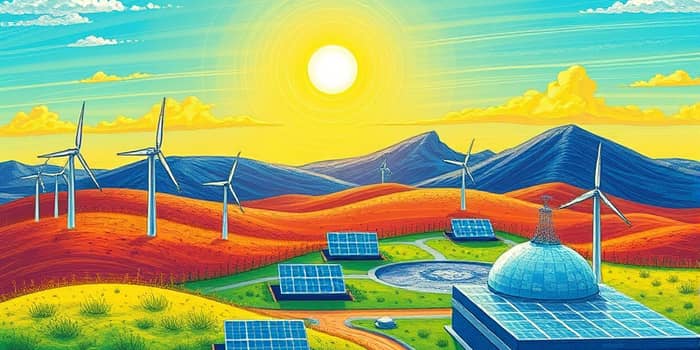
In a world grappling with climate change, the swift shift from fossil fuels to renewables has become an economic and environmental imperative. Investors, policymakers, and communities are increasingly aligning behind a shared vision: global renewable energy market growth can drive both planet and profit. As we approach 2025, the stakes—and opportunities—have never been higher.
From government halls in Brussels to solar farms in China’s deserts, every corner of the globe is staking a claim in green energy’s promise. Yet beyond headline figures lies a tapestry of innovations, policies, and bold projections that frame the true power of green investments.
Renewables now account for roughly 15% of global electricity, up from just 4% a decade ago. Spurred by declining costs, rising energy demand, and urgent climate commitments, the sector has seen its market value nearly double since 2019, jumping from $800 billion to an estimated $1.4–1.5 trillion in 2025.
This surge reflects a compound annual growth rate (CAGR) of approximately 12–15% over five years, transforming solar panels and wind turbines from niche installations into mainstream pillars of energy infrastructure.
In 2025, total world energy investment will reach $3.3 trillion, with an astonishing $2.2 trillion—double the allocation to fossil fuels—flowing into clean energy: solar, wind, nuclear, grid modernization, storage, and efficiency upgrades.
Historic figures paint a clear trajectory:
Solar power leads with a commanding 42% share, while wind commands 25–30%. Bioenergy, geothermal, and emerging sectors like advanced storage and green hydrogen fill out the remainder, each carving out niches of rapid expansion.
The expansion of cheap photovoltaic panels, sleek offshore turbines, and digital grid controls has shattered cost barriers. Yet technology alone cannot explain the boom: supportive policies, favorable financing, and competitive auctions have fueled capacity additions that outpace fossil alternatives.
Regionally, Asia-Pacific—led by China—dominates deployments. North America contributes 20–25% of the market, with US wind and solar eclipsing coal at 17% of generation. Europe’s robust policy framework under the EU Green Deal and REPowerEU keeps the region near the 20% share mark.
Government interventions remain the linchpin of renewable growth. Subsidies, tax credits, and clean energy mandates tilt the playing field, while international agreements set ambitious targets. COP28 called for tripling renewable energy capacity by 2030, aiming to move from 4,448 GW today to over 11,000 GW in five years.
Achieving that goal demands $4.5–5.5 trillion in new capital, a rallying cry for investors to join public funding and ensure the world remains on a net-zero trajectory.
Beyond wind and sun, deep decarbonization hinges on next-generation solutions. Grid-scale batteries, pumped hydro, and vehicle-to-grid integrations bolster stability. Green hydrogen offers long-duration storage and a path to decarbonize heavy industry. Digitalization—from AI-driven forecasting to virtual power plants—unlocks efficiency and resilience.
Yet despite record installations, global emissions continue to rise. Renewables must not only grow but actively displace fossil generation to avert the worst climate scenarios.
Trillions in potential returns await, but so do hurdles. Investors must navigate shifting policies, supply chain constraints, and the integration of variable resources.
The era of green investments is upon us. With global energy demand climbing, economies seeking resilience, and markets rewarding sustainability, the logic is clear: those who harness the power of renewable energy stand to gain both financially and morally.
By channeling capital into solar arrays, wind farms, storage projects, and hydrogen hubs, investors become architects of a cleaner, healthier world. The time is now to align profit with purpose, secure returns, and leave a lasting legacy for generations to come.
Join the movement: invest in renewables, champion innovative policies, and help steer humanity toward a sustainable horizon.
References